

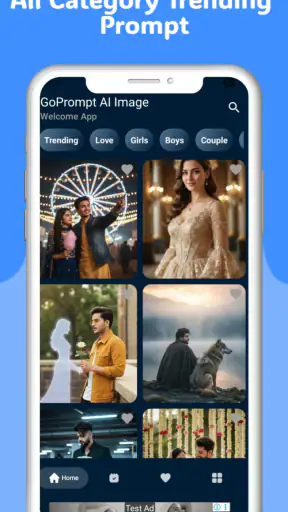
When I first opened GoPrompt - Ai Image Prompt, I understood its appeal almost immediately: it is built around turning a written idea into an image, rather than asking me to learn a complicated editing workflow first. That makes it interesting for anyone who has a scene in mind but does not have the drawing skills, time, or patience to create it manually. The app sits in the photography category, but I found it closer to a simple creative image-making tool than a traditional camera or photo editor.
The experience is intentionally direct. You start with words, describe what you want, and wait for the app to interpret that description visually. The developer is Sajjad IT, and the app is free for users who want to try this style of creation without committing to a paid photography suite. Its Everyone content rating also makes the basic concept approachable for a broad audience, including people who are completely new to AI image tools.
My main advice is to treat the first attempt as a conversation with the image generator, not as a final commission. A short phrase can produce something recognizable, but a more carefully arranged prompt gives you better control over the subject, setting, mood, and visual style. The quality of your description matters more than the length of it.
What the first launch feels like
The app’s store short description is simply GoPrompt, while its longer summary focuses on creating an AI image from text. That tells you what the central action is before you even begin: this is not an app I would install expecting a full set of manual retouching tools, layers, or camera controls. Its value is in reducing the distance between an idea and a generated picture.
On Android, it supports devices running version 9 or later, so the compatibility requirement is fairly approachable for people using an older but still usable phone. The current version is 1.9. I would still recommend opening it on a stable connection and giving the first generation a little patience, because image creation is a different kind of task from applying a quick filter to a photo already stored on your device.
The app has reached more than a million installs and holds an average rating of 4.3 from roughly thirteen thousand ratings. Those figures suggest that the basic idea has found a real audience, although they should not be confused with a guarantee that every generated image will be excellent. AI image tools can be inconsistent, especially when a prompt contains several subjects or asks for precise details.
Because it is free, GoPrompt is easy to approach as an experiment. I like that positioning for first-time users: you can test whether text-to-image creation fits your needs before replacing a familiar editor or paying for a more advanced creative platform. At the same time, free access does not automatically mean it will replace professional software. If you need exact typography, reliable character continuity, or pixel-level control, you should keep a conventional editor available.
Preparing a useful first prompt
The easiest mistake is entering a vague request such as “a beautiful landscape.” That may give you an attractive result, but it leaves too many decisions to the app. I had better results when I thought in a simple order: subject first, location second, lighting or mood third, and visual treatment last. For example, I would describe a small red bicycle beside a rainy café window at dusk, with soft cinematic lighting and a realistic photographic look.
This structure is useful because each part answers a different visual question. The subject tells the app what deserves attention. The location provides context. Lighting changes the emotional tone. The style helps guide the overall appearance. You do not need specialist vocabulary to begin; clear everyday language is often more useful than a pile of fashionable art terms.
A practical trick is to change only one part of a prompt when trying again. If the first result has the right subject but the wrong atmosphere, keep the subject and location while changing the lighting. If the composition feels too busy, remove secondary objects instead of adding more instructions. This makes it easier to understand what influenced the outcome.
I also recommend deciding what the image is for before writing the prompt. A wallpaper, social post, story illustration, product concept, and profile picture all need different framing. If you want a clean subject for later cropping, avoid filling the description with unrelated background details. If you want a scene that tells a story, include the relationship between the objects rather than listing them separately.
The first meaningful success
For a reassuring first test, I would not begin with a group portrait, a crowded city, or a scene containing readable signs. Those requests combine several difficult elements at once. Instead, choose one main object in a clear environment. A travel poster concept, a cozy reading corner, or a single animal in a natural setting is a better starting point because you can judge the result without wondering which part of the prompt caused a problem.
Once the app produces an image, inspect it with a specific checklist. Is the main subject present? Is it doing what you asked? Does the mood match the wording? Are the background elements helping the composition or distracting from it? Looking at the result this way is more productive than simply deciding whether it is “pretty.” The goal of the first attempt is to learn how GoPrompt interprets your language.
One non-obvious workflow is to write the prompt in layers before entering it. I might first create a plain description, then add one visual constraint, such as a close-up view or a warm evening atmosphere. This is more reliable than writing a long paragraph full of competing instructions. When the result is close but not quite right, I can identify the missing layer and revise it deliberately.
Another useful habit is keeping a small record of prompts that worked well. The app is most valuable when it becomes a repeatable creative shortcut rather than a one-time novelty. Saving the wording in a notes app lets me reuse a successful structure for a different subject. I can replace the object while keeping the same mood and composition, or keep the subject while testing a new setting.
For an everyday example, imagine that I need a simple image for a school presentation about local wildlife. I could describe one fox standing near a woodland path in early morning mist, with natural colors and a documentary-style appearance. That is more practical than asking for “an amazing wildlife picture,” because the subject, environment, time of day, and intended visual feeling are all clear. I would then check whether the image is suitable for the presentation before relying on it.
Where beginners may get confused
The biggest source of confusion is expecting text instructions to behave like precise design commands. If I ask for a person holding several objects, the app may interpret the arrangement loosely. If I request a specific written phrase inside the image, the lettering may not be dependable. For a poster or invitation, I would generate the visual background in GoPrompt and add the final text afterward in a dedicated design app.
Faces and hands are another reason to review the result carefully. An image can look convincing at a glance while containing small distortions that become obvious when viewed closely. I would not use an unedited result for an important portrait, identity-sensitive project, or professional client deliverable without checking it carefully and making corrections elsewhere.
Prompt length can also work against you. Beginners often assume that more detail always produces more accuracy. In practice, a long description may contain conflicting priorities. If the subject, camera angle, color palette, weather, era, and background all compete for attention, the result may feel less focused. I prefer a short core prompt followed by one or two carefully chosen refinements.
It is also important to separate creative control from editing control. A normal photo editor lets me crop, straighten, adjust exposure, and retouch a known image with predictable results. GoPrompt begins with an interpretation of language, so the result can be imaginative but less exact. I would choose it when I want ideas, atmosphere, or a fresh visual starting point. I would choose a conventional editor when I already have the correct photo and only need controlled changes.
Compared with a camera app, the difference is even clearer. A camera records a real moment and preserves the relationship between real objects. This app invents a scene from a description. That makes it useful for concepts that do not exist yet, but unsuitable when authenticity is the point, such as documenting an event, showing a real product condition, or preserving a personal memory.
Compared with a full AI art platform, GoPrompt feels more approachable because its central action is easy to understand. The trade-off is that experienced creators may eventually want more control over variations, composition, editing, or project management than a simple prompt-centered tool can provide. I would see it as a low-friction starting point, not automatically as a complete studio replacement.
How to decide whether an image is usable
Before sharing a result, I would inspect the edges and the small details, not just the center of the picture. Look at hands, jewelry, signs, repeated patterns, faces in the background, and objects that should have a definite number. These areas can reveal mistakes that are easy to miss in a thumbnail. If the image is for a casual mood board, a minor flaw may not matter. If it represents a business, person, or public-facing project, the standard should be higher.
Think about the image’s purpose and audience as well. A playful concept for a private chat can tolerate experimentation. A school assignment, social profile, or promotional graphic deserves a more careful review. I would avoid presenting an invented image as documentary evidence, especially when the visual could mislead someone about a real event or person.
One of my favorite practical uses is brainstorming. Instead of trying to produce the final artwork immediately, I can use the app to explore several directions for a room layout, a story scene, a fantasy creature, or a seasonal campaign. The generated images help me decide what mood I want. I can then recreate the strongest idea with more controlled tools if precision becomes important.
That workflow changes the way I judge the app. It does not have to deliver a perfect final image every time to be useful. If it helps me move from a blank page to three visual directions in a short session, it has already solved a real creative problem. The trade-off is that I still need judgment, revision, and sometimes another app to finish the work.
Who should use it, and who should skip it
I think GoPrompt is a good fit for curious beginners, students looking for visual inspiration, writers who want to picture a scene, and casual creators who need an original starting point without learning complicated software. It is also suitable for someone who wants to test AI image generation on an Android phone while keeping the commitment low because the app is free.
I would be more cautious about recommending it as the only tool for professional graphic design, detailed product visualization, consistent character work, or images that require exact text. A photographer who wants to organize and enhance real pictures may get more value from a traditional photo editor. Someone who needs repeatable brand assets may prefer a platform with stronger layout and editing controls.
The Everyone rating makes the app broadly approachable, but that does not remove the need for sensible prompting and review. The way an image is used matters. I would guide younger users toward harmless creative subjects and remind them that generated pictures are interpretations, not proof that something happened in the real world.
For new users wondering whether they need a powerful phone, I would begin by checking that the device runs Android 9 or later and then focus more on the quality of the prompt than on technical specifications. The app’s appeal is its simple creative entry point, not a promise that every device will produce identical results or that every request will be handled perfectly.
My next-step workflow after the first image
After a successful first generation, I would not immediately jump to complicated prompts. I would make three controlled experiments: keep the subject and change the setting, keep the setting and change the mood, then keep both and change the visual style. This teaches you what kind of language produces the look you want and helps you build confidence without wasting attempts on random wording.
For repeat projects, I would create a prompt template with spaces for subject, action, environment, lighting, and style. That makes the process faster while preserving consistency. I would also decide in advance where the image will be used, since a background intended for a phone screen should be planned differently from one intended for a square social post or a printed page.
My balanced view is that GoPrompt works best as an idea-to-image shortcut. It makes experimentation friendly, and its free availability lowers the barrier for first-time users. Its limitations appear when I need exact control, flawless small details, dependable lettering, or a carefully edited real photograph. Those are not minor distinctions; they determine whether the app belongs at the beginning of my workflow or at the end.
With an average rating of 4.3 and more than a million installs, it has enough visibility to be worth trying, but I would still judge it by a personal test rather than popularity alone. The release date was November 22, 2025, and the current version is 1.9, so I would keep the app updated through the normal platform process and judge each result on its own merits.
My final recommendation is straightforward: install GoPrompt - Ai Image Prompt if you want a simple way to turn a clear visual idea into an image and you are comfortable treating the first result as a draft. Start with one subject, one setting, and one mood. Check the details before sharing anything important, then move to a dedicated editor when you need precision. For casual creativity and visual brainstorming, that combination makes the app genuinely useful rather than merely entertaining.


